
How to Reduce the EHR’s Administrative Burden

Giving Time Back to Your Clinicians: Practical Strategies to Reduce EHR Documentation Burdens

Physician burnout is reaching crisis levels, and one of the biggest culprits is an ever-expanding documentation workload. Research shows physicians spend nearly twice as much time on EHR and desk work as they do with patients, and another one to two hours each evening finishing notes (so-called “pajama time”).

The time expense of EHR documentation contributes directly to burnout, frustration, and productivity loss. It also reduces the quality of care. The good news: with the right strategies and expert implementation, healthcare leaders can streamline clinical documentation, reduce clicks, and restore time for patients.

HPG Resources’ Healthcare Efficiency and Digital Health Solutions specialize in helping organizations reduce EHR administrative burden by combining workflow redesign, clinical engagement, and advanced technology.

Strategy 1: Build Smarter Templates & Macros

Poorly designed data entry tools create unnecessary steps. Now, it’s possible to help clinicians achieve faster, more accurate results using documentation tools optimized for real use-case scenarios:

  • Smart templates help mirror actual workflows, minimizing irrelevant or redundant entries.
  • Specialty-specific forms, offering fully custom form generation that omits irrelevant fields and prompts.
  • Macros for recurring phrases that allow clinicians to insert standard language or care plans with just a few keystrokes.
  • User-driven design, as HPG consultants conduct working client sessions to design more sophisticated templates reflecting EHR documentation best practices and workflows.
  • Cerner charting shortcuts can save hours each week by reducing clicks with personalized “smart phrases” and quick actions.

Strategy 2: Leverage Voice Recognition & Ambient Scribes

Modern dictation and ambient documentation technologies can also dramatically speed up workflows. Advanced dictation tools capture natural conversation and insert structured data directly into the EHR.

When implemented effectively:

  • Clinicians can document in real time while maintaining patient eye contact.
  • Ambient scribes automatically generate draft notes, reducing needless after-hours documentation.
  • Organizations can cut documentation time by 30–50%

HPG helps healthcare leaders choose and configure the right technologies to fit their systems, specialties, and compliance requirements — providing measurable results while honing your competitive edge.

Strategy 3: Implement Note Bloat Reduction Programs

Excessively long, redundant notes (aka “note bloat”) make records difficult to read and waste valuable time. Addressing these issues is another cornerstone to reducing physician documentation burnout.

The most successful note bloat programs should include:

  • Setting documentation standards that focus on clinical relevance, not just billing or compliance.
  • Integrated training for concise writing techniques that discourage copy-forward misuse.
  • Analytics and user feedback to track note length and duplication trends.

HPG’s consultants further analyze documentation patterns to pinpoint where notes can be streamlined without losing quality or accuracy.

Strategy 4: Optimize In-Basket Management

In-basket overload is another hidden time drain. For each clinician, various messages, prompts, and notifications can number in the hundreds daily.

To streamline communication, ensure your documentation management tools:

  • Route non-clinical tasks to the right support staff.
  • Use team pools to share message workloads.
  • Adjust alert settings to eliminate low-value notifications.

HPG workflow experts evaluate message volume, routing rules, and team configurations to create a sustainable, less stressful system for every clinic.

Strategy 5: Use Data Integration to Reduce Manual Entry

Disconnected systems force clinicians to enter data multiple times — a top complaint among EHR users. Seamless data integration ensures labs, imaging, and ancillary systems automatically populate relevant patient records.

Through optimized interfaces and interoperability solutions, HPG helps organizations reduce manual entry, improve accuracy, and reclaim time lost to repetitive tasks.

Reclaim Your Time for Greater Healthcare Service Quality

Ultimately, the goal of EHR documentation isn’t just improving administrative efficiency; streamlining documentation workflows means giving time back to clinicians. These benefits translate directly to higher quality of care and reducing burnout throughout your organization.

HPG Resources combines deep EHR expertise with clinical insights to implement novel solutions that ensure the technology serves your staff — not the other way around.

Contact us to request a complimentary Documentation Workflow Review with an HPG clinical expert today, and take the first step toward designing an EHR that truly supports your team.


Image credit: BongkarnGraphic / Shutterstock

How to Build Your EHR Implementation Project Plan & Budget

EHR can be a real game-changer for your facility, simplifying and improving your operations. Finding the right way to implement this technology can be a challenge all on its own, however. An EHR implementation is 80% planning and 20% execution, so your best bet is to get planning. If you’re managing this change to your operations, here’s what to know about making this project a success and how HPG can help you do that.

Assembling Your A-Team: Roles & Responsibilities

The success of your EHR implementation largely depends on the team you assemble. Each member must work to navigate the complexities of the project. Examine the key players and their respective contributions closely:

Project Manager

This person is the linchpin of the project, orchestrating the entire process. They craft the project plan, keep the timeline on track, and act as the bridge between your facility and the EHR vendor. Their leadership keeps the project moving forward and tackles any challenges head-on.

Clinical Lead

Usually, a healthcare professional, the clinical lead, ensures the EHR system meets the clinical needs of your organization. They translate clinical workflows into system requirements and serve as the voice of the end-users, ensuring seamless communication between clinical staff and IT.

IT Specialist

As the tech guru of the team, the IT specialist handles system integration, data migration, and network setup. Their job is to ensure the EHR system meshes well with existing technologies and maintains robust data security.

Training Coordinator

To ensure everyone is comfortable with the new system, the training coordinator develops a program to help everyone get up to speed on how to use it. They create materials, schedule sessions, and provide ongoing support after integration is complete, ensuring users are confident and capable.

Change Management Lead

This role is all about easing the transition. The change management lead prepares staff for new workflows, addresses any resistance, and promotes a culture of adaptability, which is all needed to make implementation easier.

Finance Officer

Keeping an eye on the budget, the finance officer tracks all financial aspects of the project. They work closely with the project manager to monitor spending and adjust the budget as needed to handle unexpected costs.

Creating the Master Project Roadmap

With your team ready, it’s time to create the project roadmap. You start with the Discovery phase, where your team gathers essential requirements and evaluates current workflows to determine how best to go about the implementation. Next, move to the Design phase to develop system specifications for your needs.

During the Build phase, you can configure the EHR system to fit your organization. Testing follows, letting you identify and resolve any issues before training staff in the Train phase. Go-Live marks the official launch, and the Optimize phase focuses on refining processes and addressing any post-launch challenges.

Visual tools like Gantt charts are invaluable for tracking progress and maintaining transparency. They offer a clear view of timelines, dependencies, and milestones, ensuring the project stays on track and within scope.

Budgeting for Everything: The Hidden Costs of EHR

A thorough budget accounts for both obvious expenses and hidden costs that can disrupt your EHR implementation project if ignored. List out the essential expenses, such as software licensing fees, hardware upgrades, and IT infrastructure improvements, that you absolutely need. Don’t overlook costs for third-party interfaces, which are often necessary for integrating the EHR with existing systems. Plan for potential overtime pay during critical phases like Go-Live.

Make sure to allocate funds for unexpected expenses, such as additional training sessions or post-launch support. A flexible budget will help you manage unforeseen costs without compromising the project’s success.

Resource Allocation & Management

Efficient resource allocation maintains momentum and prevents burnout during your EHR implementation. Assess the availability and expertise of your internal team members to ensure they meet the project’s demands.

Coordinate with your implementation partner to align timelines and responsibilities. Regular check-ins and clear communication channels will help prevent misunderstandings and ensure cohesive teamwork. Balancing project tasks with day-to-day operations avoids staff fatigue and maintains morale. Use project management tools to allocate resources effectively, track progress, and adjust workloads as needed.

Plan Your EHR Implementation Project Today

A well-structured EHR implementation project plan is your best defense against chaos. By assembling a strong team, creating a detailed roadmap, budgeting wisely, and managing resources effectively, you can confidently navigate the complexities of EHR implementation.

HPG’s expert project management services are designed to support you every step of the way, ensuring your project is executed seamlessly and on budget. Contact us today to learn how we can help you build and manage your EHR implementation plan with confidence.


Image credit: PeopleImages / Shutterstock

The Comprehensive Guide to EHR System Selection and Implementation

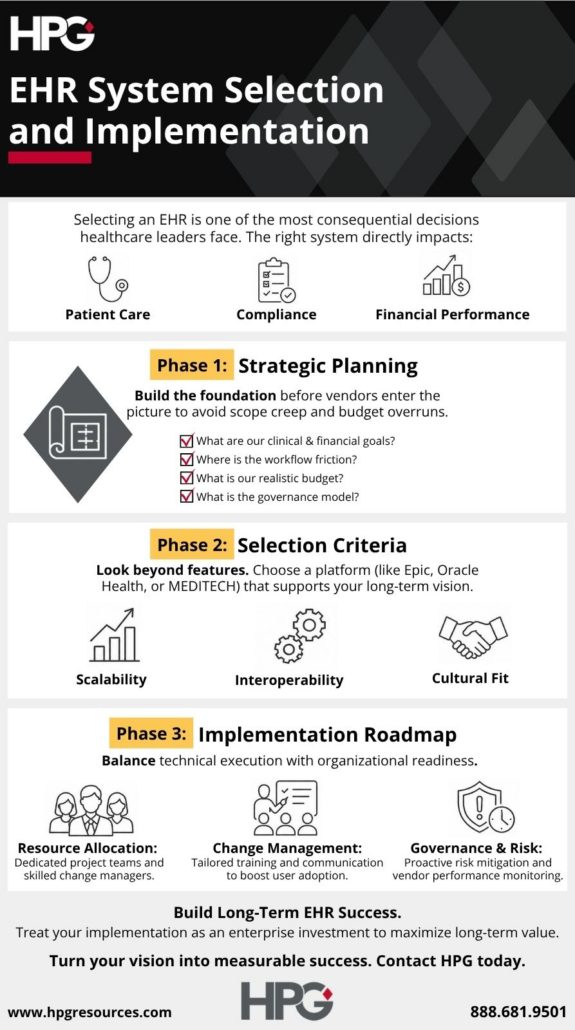
Selecting and implementing an EHR is one of the most consequential technology decisions healthcare leaders face. The right system affects patient care, compliance, and long-term financial performance. This EHR implementation guide offers senior executives and IT leaders a strategic blueprint, covering system selection and deployment from planning to execution. With a clear roadmap, you can reduce risk, align technology with organizational goals, and achieve lasting value.

Phase 1: Strategic Planning for EHR Implementation

Before vendors enter the picture, leaders must create a foundation for success. Strategic planning ensures the EHR project aligns with long-term goals and addresses organizational pain points. Skipping this step often leads to scope creep, budget overruns, and poor adoption.

Key questions to guide the planning phase include:

  • What clinical and financial outcomes do we want to achieve?
  • Which existing workflows create the most friction for staff or patients?
  • How much capital and operational funding can we realistically dedicate?
  • What governance model will oversee the project from start to finish?

By answering these questions early, executives can align expectations, secure stakeholder buy-in, and establish a clear direction for the initiative.

HPG recently partnered with a regional health system that struggled with fragmented workflows across multiple sites. By leading a structured planning process, we helped executives prioritize clinical outcomes and align technology goals with a five-year growth plan. This early alignment avoided costly missteps and positioned the project for long-term success.

Phase 2: Criteria for EHR System Selection

Choosing the right platform goes beyond comparing features. Senior leaders must evaluate how a system fits the organization’s long-term vision, integrates with existing infrastructure, and supports clinical and financial performance. Platforms like Epic, Oracle Health, and MEDITECH dominate the market, but their suitability depends on alignment with your priorities.

For example, HPG guided a multi-hospital network through vendor selection by comparing scalability and interoperability across Epic and Oracle Health. By weighing cultural fit alongside technical requirements, leaders chose a platform that supported growth and reduced integration risks.

Evaluating Scalability and Interoperability

A strong system should scale with growth, whether you add new facilities or expand service lines. Interoperability ensures seamless data exchange with external providers, payers, and patients, improving care coordination and regulatory compliance.

Assessing Cultural Fit

Understanding how to choose an EHR system involves more than technical capability. A good cultural fit reflects your workflows, leadership style, and tolerance for change. Systems that align with organizational culture foster smoother adoption and long-term success.

Phase 3: EHR Implementation Roadmap

Even the top system fails without a straightforward EHR implementation process. Leaders need a structured approach that balances technical execution with organizational readiness. A successful roadmap defines timelines, allocates resources, and prepares staff for lasting change. It also sets performance benchmarks so executives can measure progress and adjust strategies.

Resource Allocation and Change Management

Electronic health record implementation requires dedicated project teams and skilled change managers. Training programs, user support, and communication channels reduce resistance and help staff adapt quickly. Prioritizing people alongside technology creates momentum and builds confidence across the organization.

In one community hospital project, HPG designed tailored training programs and governance structures that kept staff engaged. The result was a rapid implementation delivered on time and within budget, with staff adoption rates exceeding initial targets.

Governance and Risk Mitigation

Strong governance keeps projects on track. Leaders should establish committees to oversee scope, budget, and compliance. Proactive risk management, including contingency planning and vendor performance monitoring, ensures the EHR project plan adapts to challenges while maintaining alignment with organizational goals.

Building Long-Term EHR Success

Practical EHR projects demand strategic planning, careful EHR system selection, and disciplined execution. When leaders treat implementation as an enterprise investment, they reduce risk and maximize long-term value. HPG Resources collaborates with executives to design and deliver strategies aligning technology with organizational goals.

Contact us at HPG Resources today for guidance that turns vision into measurable success.


Image credit: EliteExposure / Shutterstock